AI Essay Outline Ethics: Is Using ChatGPT for Assignments Cheating? (2026)

In 2026, the line between "smart researching" and "academic dishonesty" is blurrier than ever. Many students now ask whether using ChatGPT for essay outlines is cheating or a legitimate study method under modern university rules. Universities are cracking down on AI plagiarism, yet they also expect students to use modern tools to be efficient.
This guide breaks down exactly where the "Green Zone" (Safe/Smart Work) ends and the "Red Zone" (Danger/Cheating) begins, ensuring you maintain high ethical standards without falling behind.
Is Using ChatGPT for Essay Outlines Considered Cheating?
The first question every student asks is: "If I only get an idea from AI, is that cheating?" The answer depends entirely on your Intent.
Students confused about AI usage should also understand how plagiarism detection tools work, which we explain in our guide on how Turnitin detects AI-written assignments.
University professors and Academic Integrity Boards generally divide this into two categories:
- Assistance: Using AI as a "Smart Friend" or tutor that explains a topic or suggests a structure.
- Replacement: Using AI to do the thinking and writing for you.
Professors rarely have an issue with the tools themselves; their problem is with "Cognitive Offloading"—when you stop applying your own critical thinking and skip the learning process entirely.
How Students Can Use AI for Essay Outlines Without Cheating
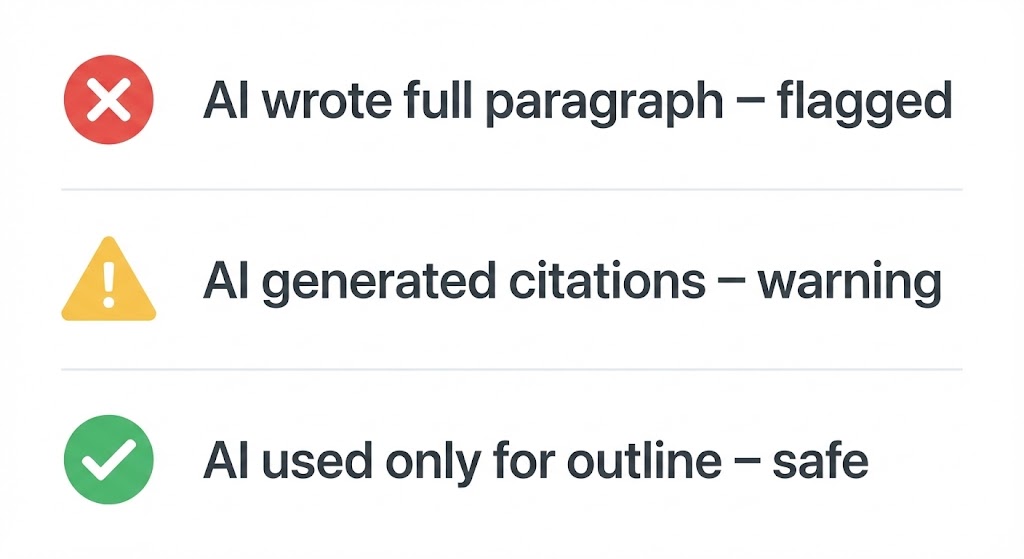
If you want to stay safe and protect your GPA, use AI strictly for the Process, never for the Product (the final essay).
Strategy A: Brainstorming & Outlining
If you are assigned an essay on "The Fall of the Roman Empire," staring at a blank page is inefficient. It is acceptable to ask AI:
"Act as a history tutor. Give me 5 key arguments for why the Roman Empire fell, focusing on economic factors."
This is not cheating. It is functionally the same as checking a library index. You receive "Points," but expanding and writing them remains your responsibility.
Strategy B: Organizing Messy Notes (Grounded AI)
Students often end up with 50 pages of rough notes. We recommend using NotebookLM. Unlike standard chatbots, NotebookLM does not pull data from the open internet. It reads only the documents you upload. This eliminates the risk of "Fake Facts."
When Using AI for Assignments Becomes Academic Misconduct
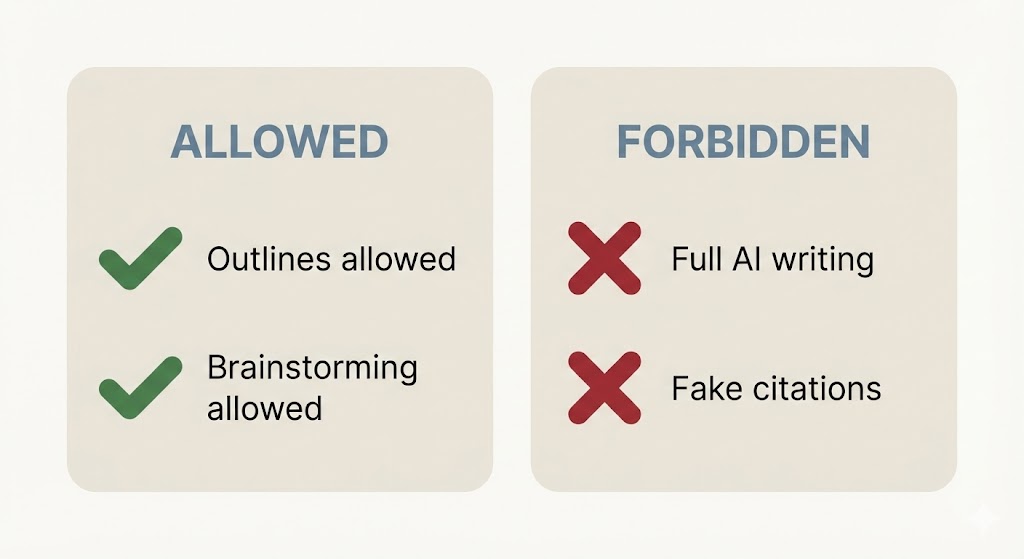
Here are the specific mistakes that trigger Plagiarism Checkers like Turnitin or GPTZero.
Trap #1: The "Copy-Paste" Mistake
If you have ChatGPT write your entire introduction and paste it into your essay—even if you change a few words—you will likely be caught. AI sentence structure is notoriously "perfect" and predictable.
Trap #2: Fake Citations (The Biggest Risk)
This is the most dangerous trap. AI models often generate names of books and papers that do not exist (Hallucinations). If your professor checks a fake source, you will face an "Academic Misconduct" hearing.
How I Recommend Students Actually Use ChatGPT (Safely)
In 2026, the "Smart Student" is one who makes AI an Assistant, not the Author. Follow this workflow:
- Ideation: Ask AI for a list of "Pros and Cons".
- Structuring: Ask, "What is a logical flow for these arguments?"
- Verification: Verify original sources.
- Drafting: Write the final draft yourself using your own voice.
Pro Tip: Students who already use tools like ChatGPT should also understand how AI tools impact academic integrity, which we explained in our guide on Google AdSense and AI-generated content.
Conclusion
Using AI is not wrong; making it a Crutch is. If you use AI to generate an outline so you can spend more time on deep research, that is Smart Work.
For most universities, using ChatGPT for essay outlines is acceptable only when students remain the original authors of their assignments.
My Experience: What Happened When I Used AI for an Assignment
I decided to test this myself. Instead of guessing university rules, I used ChatGPT to help with an actual college-style assignment and observed what felt safe—and what immediately felt risky.
First, I asked ChatGPT to generate a complete essay draft. The result was polished, confident, and dangerously perfect. When I read it back, it didn’t sound like me. The sentences were too clean, the structure too balanced. If I were a professor, this would have raised questions instantly.
Next, I tried a different approach. I used ChatGPT only to create an outline—main points, subheadings, and argument flow. Then I closed the tool and wrote the essay myself, using my own words, examples, and references.
The difference was obvious. The outline saved time, but the thinking and writing were still mine. There was no artificial tone, no generic phrasing, and no dependency on AI-generated citations.
This made one thing clear to me: when AI does the writing, it replaces your thinking. When AI only helps you organize ideas, it supports your thinking. That difference matters more than most students realize.
AI-Generated Assignment Sample (For Demonstration)
To test how AI-generated academic writing actually looks, I generated a one-page assignment using AI. This sample is shared only for educational discussion, not for academic submission.
⚠️ This PDF is an AI-generated sample shared strictly for learning and ethical discussion.
Frequently Asked Questions
Is using ChatGPT for essay outlines cheating?
Using ChatGPT for essay outlines is generally not considered cheating if it is limited to planning and brainstorming rather than generating full paragraphs.
Can universities detect AI-generated essays?
Yes, universities use tools like Turnitin and AI detectors to identify content that is fully or mostly generated by AI.
Is AI allowed for college assignments?
Most universities allow limited AI use for research and outlining, but students must write the final content themselves.