
In the EdTech arms race, 2026 quietly became the year of listening instead of reading. Information is no longer scarce; attention is. For students and lifelong learners, the real problem isn’t finding material—it’s surviving the volume without burning out.
Two tools now dominate this shift toward audio-first learning: ChatGPT Voice and Google NotebookLM. On the surface, both speak. Underneath, they solve very different problems.
If you’re a student choosing between a paid AI assistant and Google’s growing ecosystem—or trying to decide how these tools fit into serious exam preparation—this guide is for you. We’ll break down how each platform turns written material into audio, and more importantly, which workflow actually helps you retain information instead of just consuming it.
The Core Difference: Generalist vs. Grounded
To decide which tool actually helps you study better, you need to understand how each one handles information. This difference isn’t cosmetic—it directly affects accuracy, trust, and how safely you can use these tools for academic work.
| Feature | ChatGPT Voice | Google NotebookLM |
|---|---|---|
| Core Role | Reasoning-focused generalist | Source-bound specialist |
| Primary Knowledge Source | Pre-trained knowledge + live reasoning | Only your uploaded documents |
| Reliability | Variable (can fabricate if unguided) | High (responses tied to sources) |
| Learning Style | Active, conversational, interruptible | Passive, linear, podcast-style |
ChatGPT Voice: The Conversational Generalist
ChatGPT Voice works like a fast-thinking study partner with a broad, internet-level understanding of almost everything—but no guaranteed familiarity with your exact syllabus. It shines when you’re trying to grasp big-picture ideas, simplify complex topics, or think out loud. Ask it to “explain quantum physics like I’m five,” and it delivers.
The trade-off is reliability. Because ChatGPT reasons beyond fixed sources, it can sometimes fill gaps with confident-sounding guesses when questions get too specific or poorly constrained. Used casually, this isn’t a problem. Used blindly for exams, it can be.
NotebookLM: The Source-Bound Specialist
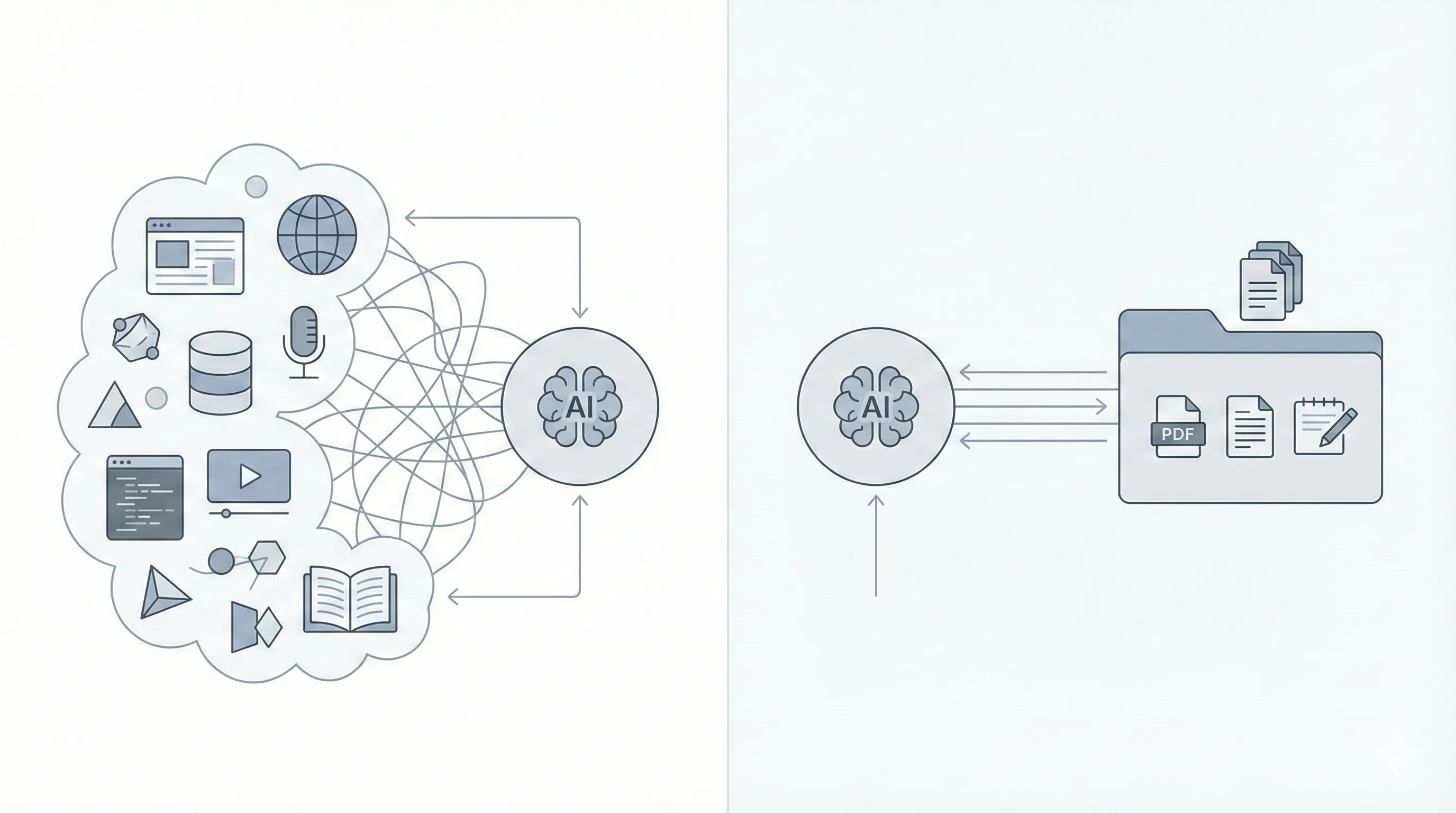
NotebookLM takes the opposite approach. It doesn’t generalize—it anchors. The model only works with the material you provide, whether that’s PDFs, lecture notes, Google Docs, or research papers. Instead of reasoning freely, it reorganizes, summarizes, and discusses your sources.
This makes NotebookLM far more predictable. It won’t invent facts, but it also won’t go beyond what’s in your documents. In other words, it trades creativity and abstraction for control and academic safety.
What Using NotebookLM Audio Actually Feels Like After a Week
After several days of using NotebookLM’s Audio Overview with real course material, a clear pattern emerges. The tool works best as an intake layer, not a replacement for studying. Listening to your own notes helps you identify weak areas, surface recurring themes, and build familiarity with dense material before sitting down to actively revise it.
However, retention improves only when listening is followed by engagement. Students who treat the audio like a podcast to “finish” their syllabus tend to overestimate how much they remember. Those who pause afterward to summarize, annotate, or test themselves benefit far more. NotebookLM accelerates exposure—but understanding still requires effort.
Feature Deep Dive: The Auditory Experience
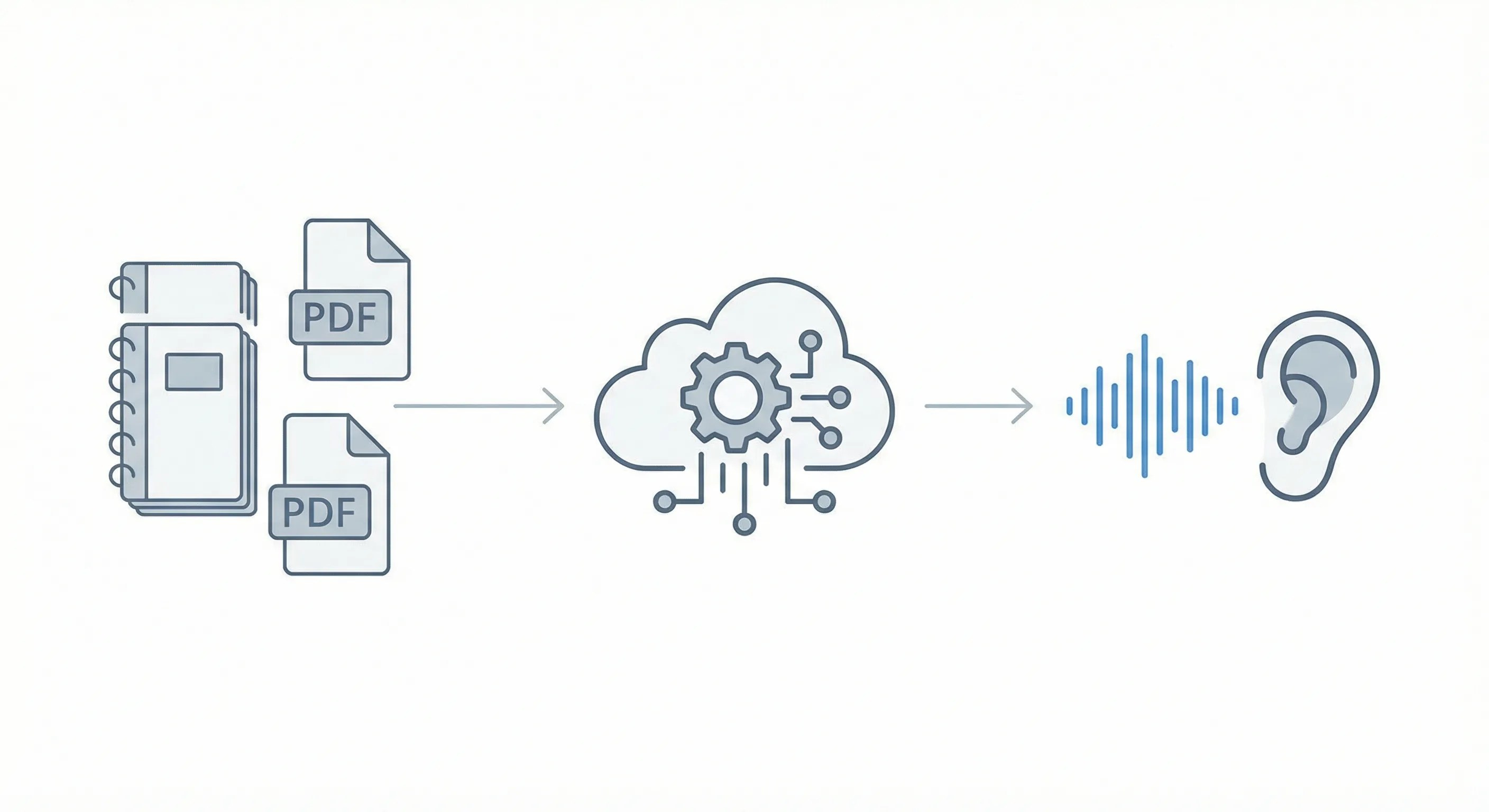
For auditory learners, the voice itself matters—but the structure of delivery matters even more. Tone, pacing, repetition, and narrative flow all influence whether listening leads to retention or just background noise.
The NotebookLM Experience
NotebookLM’s “Audio Overview” is designed as a hands-off listening experience, closer to a curated podcast than a voice assistant.
- The “Podcast” Effect: Two AI hosts discuss your uploaded material conversationally. They pause, react, simplify ideas, and surface patterns across your notes, which helps with long-form comprehension rather than line-by-line recall.
- Low-Friction Consumption: This format works well during low-attention moments—commuting, workouts, or routine tasks. You don’t steer the conversation; you absorb a structured summary of large volumes of material.
The limitation is control. You can’t interrupt, challenge a point, or ask for clarification mid-flow. NotebookLM assumes listening is enough—and for some learners, that assumption holds. For others, it doesn’t.
Where Audio-First Learning Breaks Down
Audio summaries are powerful, but they have limits. Complex diagrams, equations, and step-by-step problem solving often lose clarity when converted into spoken explanations. In subjects like mathematics, physics, or programming, listening alone can create false confidence without real comprehension.
There’s also the risk of passive familiarity. Hearing concepts repeatedly can feel productive, even when recall remains weak. Without deliberate follow-up—such as testing yourself or revisiting the source material—audio learning can reinforce recognition rather than mastery.
Workflow Integration: Building a Second Brain
For serious students, AI tools stop being novelties and start becoming infrastructure. NotebookLM fits best when treated as a processing layer inside a larger study system rather than a standalone solution.
Why Listening Feels Effective (and When It Isn’t)
Auditory learning works best when it reduces cognitive load and reinforces patterns, not when it replaces active recall. Listening helps build mental context and familiarity, but long-term memory forms through retrieval—testing, summarizing, and applying information.
Common Mistakes Students Make with Audio AI Tools
- Confusing familiarity with understanding: Hearing concepts repeatedly feels productive, but without recall or application, long-term retention remains weak.
- Replacing study with listening: Audio tools work best as a supplement, not a substitute for active revision, problem-solving, or note-making.
- Ignoring subject limitations: Diagram-heavy, numerical, or procedural topics often require visual or hands-on practice beyond audio summaries.
- Blind trust in outputs: Even grounded tools depend on input quality. Poor notes lead to poor summaries.
This is why audio tools work differently for different learners. For some, they unlock focus and reduce friction. For others, they serve best as a preparatory layer before deeper study. Understanding this distinction prevents overreliance on passive listening.
Final Verdict: When to Use Which?
Audio-first tools like NotebookLM are especially useful in exam-heavy disciplines where volume is the main enemy—law, medicine, humanities, and theory-based courses. In these contexts, speed of exposure and accuracy matter more than creative exploration.
You don’t actually have to choose one tool and abandon the other. The most effective students in 2026 use these systems at different stages of learning—because no single AI covers the entire cognitive loop.
Use ChatGPT Voice when:
- You’re stuck on a concept and need it explained from multiple angles.
- You want to think out loud, test ideas, or stress-test an argument.
- You need interactive practice—interviews, presentations, or rapid clarification.
Use NotebookLM when:
- You’re facing a large volume of source material and need it compressed fast.
- Your priority is accuracy and traceability, not speculation.
- You want to absorb your own notes through audio during low-attention time.
Conclusion
If your goal is to listen through your actual course material without reading hundreds of pages, Google NotebookLM is the safer and more predictable choice. Its ability to transform static documents into a structured, podcast-style discussion is something ChatGPT Voice does not currently replicate.
That said, passive listening can create the illusion of learning. The students who benefit most are the ones who listen first, then return to the material actively—questioning, summarizing, and testing their understanding. Used this way, NotebookLM becomes a powerful intake tool, while ChatGPT Voice handles exploration and reasoning.
Frequently Asked Questions
Is NotebookLM better than ChatGPT Voice for studying?
NotebookLM is better for summarizing and listening through your own study material with high accuracy. ChatGPT Voice is better for interactive learning, explanations, and reasoning through unfamiliar concepts.
Can I rely only on audio learning for exams?
No. Audio learning improves exposure and familiarity, but long-term retention requires active recall, practice questions, and engagement with the material.
Does NotebookLM hallucinate like other AI tools?
NotebookLM does not invent information because it is limited to the sources you upload. However, its output quality depends entirely on the accuracy and completeness of those sources.
Which students benefit most from NotebookLM Audio Overview?
Students dealing with large volumes of reading—such as law, medicine, humanities, and theory-heavy subjects—benefit the most from audio summaries.
Is ChatGPT Voice unsafe for academic use?
No, but it requires careful prompting and verification. ChatGPT Voice is best used for exploration and clarification rather than memorizing exam-critical facts.